In The Travels of Dean Mahomet: An Eighteenth-Century Journey through India, Dean Mahomet explicitly uses anti-establishment rhetoric in a romanticized way to challenge the West. This could go to the point that Mahomet explicitly analyzes Asian landscapes paintings to strengthen his anti-establishment rhetoric against the West. Mahomet’s anti-establishment rhetoric against the West could prove Edward Said’s theory of Orientalism when Said said that “the assertion of personal, authentic, sympathetic, and humanistic knowledge of the Orient as far as it would go in its struggle with the archive of official European knowledge about the Orient” (Said 197). This could give us a sense on how Dean Mahomet glorified India and numerous Asian landscapes when he said that the Indian people “are peculiarly favoured by Providence in the possession of all that can cheer the mind in the eye, and tho’ the situation of Eden is only traced in the Poet’s creative fancy, the traveller beholds with admiration the face of this delightful country, on which he discovers tracts that resemble those so finely drawn by the animated pencil of Milton” (Mahomet 34). This clearly demonstrates how Mahomet is romanticizing India and numerous Asian landscapes paintings as a way to build his anti-establishment rhetoric to challenge the West. This could give us a sense that throughout Mahomet’s career, he was considered to be an anti-imperialist. This could also give us a sense that the anti-imperialist rhetoric of Mahomet could go to the point of what Edward Said said that “the Orient was overvalued for its pantheism, its spirituality, its stability, its longevity, its primitivity, and so forth” (Said 150).
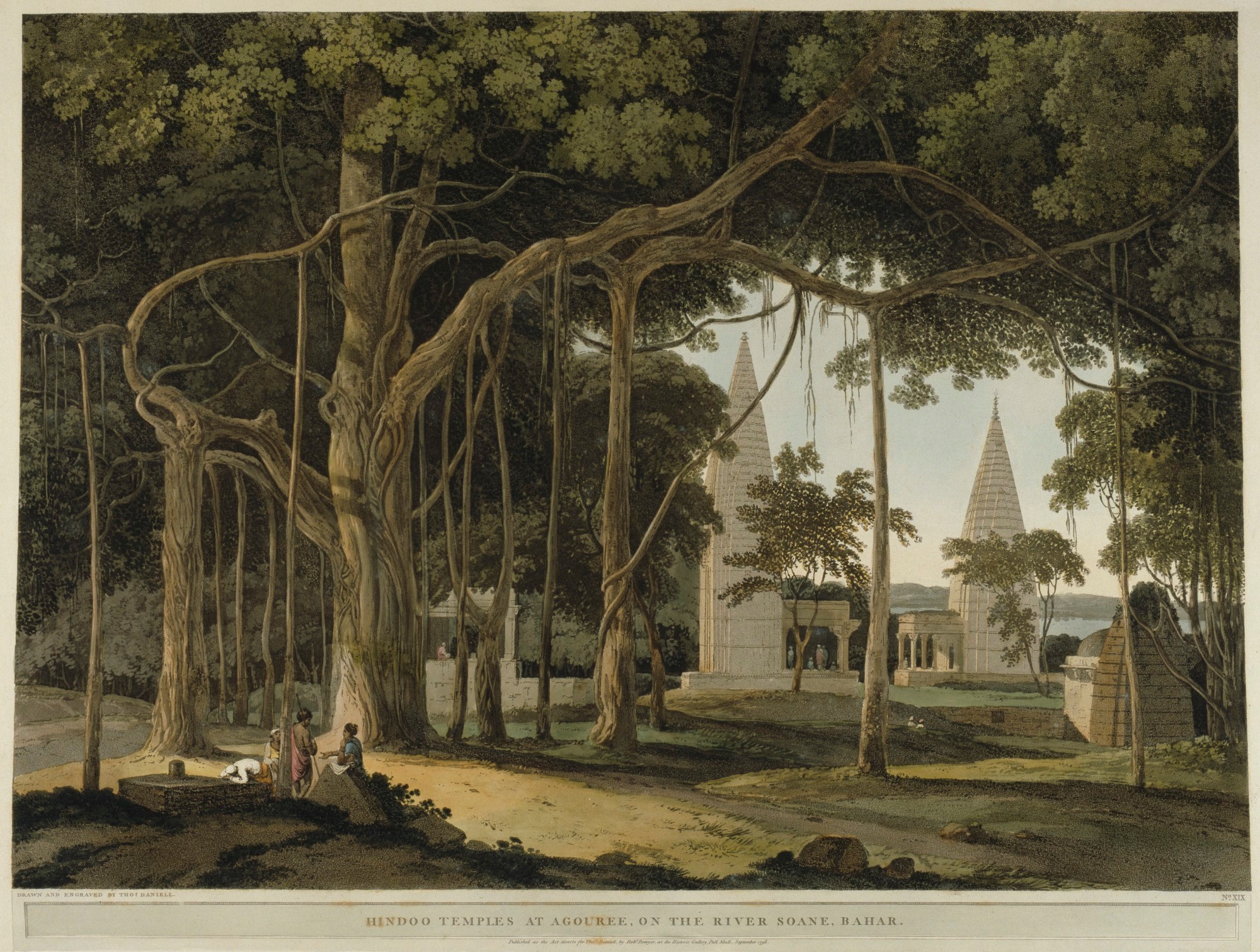
It is well considered that there is one painting by Thomas Daniell that can help us analyze the anti-establishment rhetoric of Dean Mahomet. The specific painting that an help us analyze the anti-establishment rhetoric of Dean Mahomet is the Hindoo Temples at Agouree, on the River Soane, Bahar (September 1796). This could go to the point that this painting gives us a complete accuracy of how the Orient looks like for centuries. This could give us a sense that this painting is instrumental in giving us an accurate survey of the Orient in terms of its religion, culture, and customs. This could also give us a sense that this painting goes along with Edward Said’s theory of Orientalism when Said said that glorifying the Orient was a way “to reconstruct a dead or lost Oriental language meant ultimately to reconstruct a dead or neglected Orient” (Said 123). This could also give us a sense on how Dean Mahomet would accurately analyze this painting by saying that “over the aromatic plains and spicy groves that adorned the landscape below, commanding an extensive prospects of all the fertile vales along the winding Ganges flowery banks” (Mahomet 41). This clearly demonstrates how Mahomet would use an extremely accurate angel to glorify the landscape paintings of the Orient. This could give us a sense that Mahomet’s careful analysis of this painting is instrumental in helping us overcome the long legacy of racism and xenophobia. Mahomet’s careful analysis of this painting is also instrumental in glorifying the Orient to the point in asking where “the human sympathy has gone, into what realm of thought it has disappeared while the Orientalist vision takes place” (Said 154). This could give us a sense on how Mahomet’s careful analysis of this painting allowed Karl Marx to become under the impression that “England has to fulfill a double mission in India: one destructive, the other regenerating” (Said 154). This could also give us a sense on how Mahomet’s careful analysis of this painting allowed Karl Marx to become under the impression in “how Marx’s moral equation of Asiatic loss with the British colonial rule he condemned gets skewed back towards the old inequality between the East and West” (Said 154). This clearly demonstrates how imperialism inflicts severe inequality. This could give us a sense that these accurate Asian landscape paintings is instrumental in glorifying the Orient. This could also give us a sense that these accurate Asian landscape paintings is very instrumental in helping us overcome the long hated legacy of racism and xenophobia.
 The People's Friend