Be yourself; Everyone else is already taken.
— Oscar Wilde.
This is the first post on my new blog. I’m just getting this new blog going, so stay tuned for more. Subscribe below to get notified when I post new updates.
Be yourself; Everyone else is already taken.
— Oscar Wilde.
This is the first post on my new blog. I’m just getting this new blog going, so stay tuned for more. Subscribe below to get notified when I post new updates.
In The Travels of Dean Mahomet: An Eighteenth-Century Journey through India, Dean Mahomet explicitly uses anti-establishment rhetoric in a romanticized way to challenge the West. This could go to the point that Mahomet explicitly analyzes Asian landscapes paintings to strengthen his anti-establishment rhetoric against the West. Mahomet’s anti-establishment rhetoric against the West could prove Edward Said’s theory of Orientalism when Said said that “the assertion of personal, authentic, sympathetic, and humanistic knowledge of the Orient as far as it would go in its struggle with the archive of official European knowledge about the Orient” (Said 197). This could give us a sense on how Dean Mahomet glorified India and numerous Asian landscapes when he said that the Indian people “are peculiarly favoured by Providence in the possession of all that can cheer the mind in the eye, and tho’ the situation of Eden is only traced in the Poet’s creative fancy, the traveller beholds with admiration the face of this delightful country, on which he discovers tracts that resemble those so finely drawn by the animated pencil of Milton” (Mahomet 34). This clearly demonstrates how Mahomet is romanticizing India and numerous Asian landscapes paintings as a way to build his anti-establishment rhetoric to challenge the West. This could give us a sense that throughout Mahomet’s career, he was considered to be an anti-imperialist. This could also give us a sense that the anti-imperialist rhetoric of Mahomet could go to the point of what Edward Said said that “the Orient was overvalued for its pantheism, its spirituality, its stability, its longevity, its primitivity, and so forth” (Said 150).
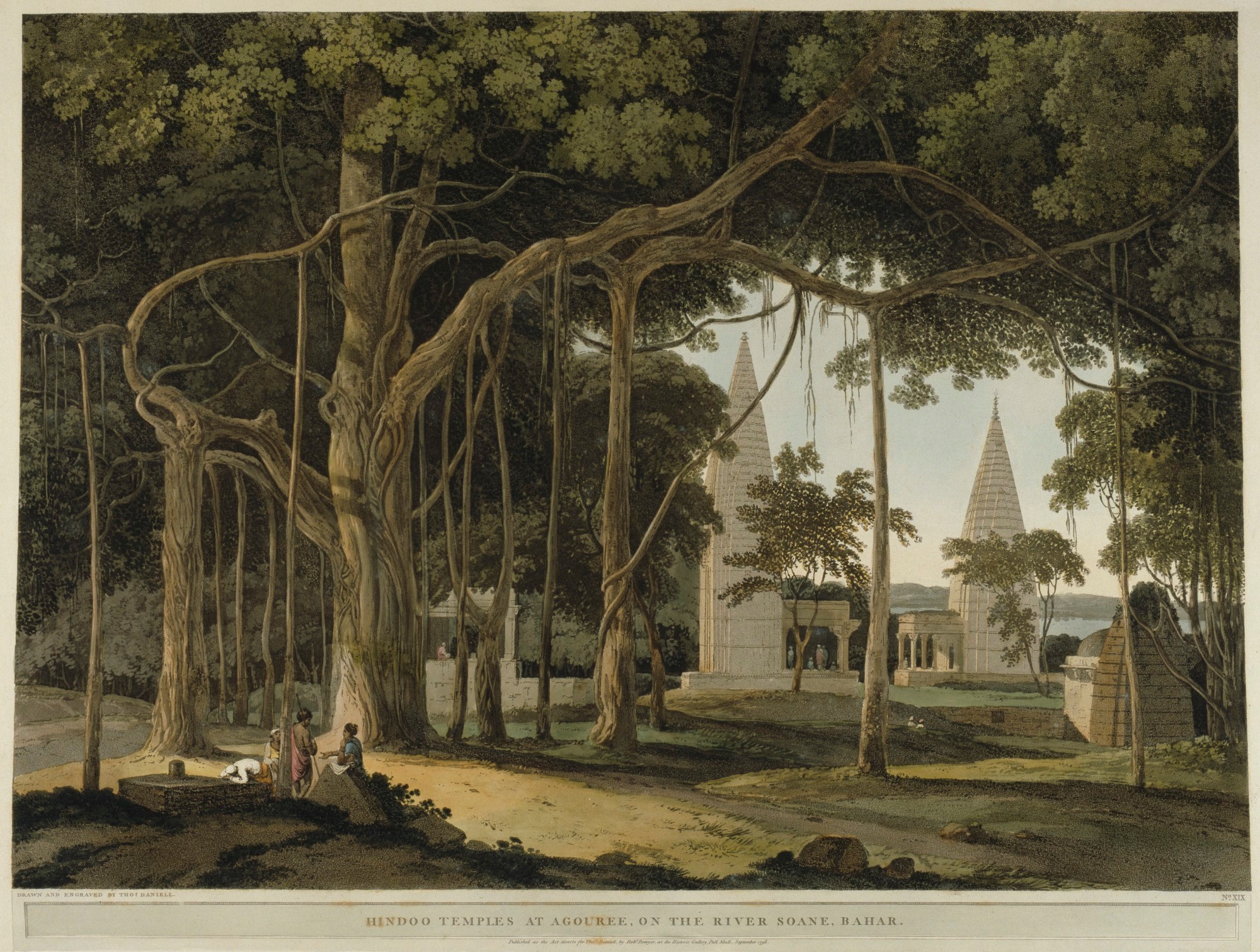
It is well considered that there is one painting by Thomas Daniell that can help us analyze the anti-establishment rhetoric of Dean Mahomet. The specific painting that an help us analyze the anti-establishment rhetoric of Dean Mahomet is the Hindoo Temples at Agouree, on the River Soane, Bahar (September 1796). This could go to the point that this painting gives us a complete accuracy of how the Orient looks like for centuries. This could give us a sense that this painting is instrumental in giving us an accurate survey of the Orient in terms of its religion, culture, and customs. This could also give us a sense that this painting goes along with Edward Said’s theory of Orientalism when Said said that glorifying the Orient was a way “to reconstruct a dead or lost Oriental language meant ultimately to reconstruct a dead or neglected Orient” (Said 123). This could also give us a sense on how Dean Mahomet would accurately analyze this painting by saying that “over the aromatic plains and spicy groves that adorned the landscape below, commanding an extensive prospects of all the fertile vales along the winding Ganges flowery banks” (Mahomet 41). This clearly demonstrates how Mahomet would use an extremely accurate angel to glorify the landscape paintings of the Orient. This could give us a sense that Mahomet’s careful analysis of this painting is instrumental in helping us overcome the long legacy of racism and xenophobia. Mahomet’s careful analysis of this painting is also instrumental in glorifying the Orient to the point in asking where “the human sympathy has gone, into what realm of thought it has disappeared while the Orientalist vision takes place” (Said 154). This could give us a sense on how Mahomet’s careful analysis of this painting allowed Karl Marx to become under the impression that “England has to fulfill a double mission in India: one destructive, the other regenerating” (Said 154). This could also give us a sense on how Mahomet’s careful analysis of this painting allowed Karl Marx to become under the impression in “how Marx’s moral equation of Asiatic loss with the British colonial rule he condemned gets skewed back towards the old inequality between the East and West” (Said 154). This clearly demonstrates how imperialism inflicts severe inequality. This could give us a sense that these accurate Asian landscape paintings is instrumental in glorifying the Orient. This could also give us a sense that these accurate Asian landscape paintings is very instrumental in helping us overcome the long hated legacy of racism and xenophobia.
It is well considered that Elizabeth Hamilton uses a tiny friction of anti-Islamic rhetoric to promote a counter-hegemonic discourse and prove that Edward Said’s theory of Orientalism as a reliable theory. This could go to the point that when Hamilton tries to prove Said’s theory of Orientalism as trustworthy, she tries to help us overcome the long hated legacy of racism, xenophobia, and imperialism. This could give us a sense that Hamilton is using anti-establishment rhetoric to prove Said’s theory of Orientalism dependable. It is well consisted that Hamilton was keenly aware that “writers in every branch of Oriental literature, have to contend with disadvantages, too numerous and too powerful to be easily overcome” (Hamilton 55). This could go to the point that most Oriental writers “will operate with equal force on the most beautiful passages of Homer, or Virgil, and the names of Glaucus and Sarpedon, of Anchises and Eneas, be found as hard to remember, and as difficult to pronounce, as those of Krishna and Arjoun” (Hamilton 55-56). This clearly demonstrates how numerous Oriental writers were blind by their hate and ignorance. This brings the issue of social acceptance. It is will consisted that most Oriental writers were championing social rejection due to their pathological lying. This could give us a sense on how numerous Oriental writers were lying all of the time to justify white supremacy and traumatize people of color. This could also give us a sense on how Chris Hedges would view Orientalism and compare it to how the liberal elites who poisoned our societies. This comparison is very clear in the Death of the Liberal Class (2010) when Hedges would describe the true characteristic of most Oriental writers in which “the liberal class, especially its most elitists and snobbish elements, was used to help distance art from the masses” (Hedges 113). This could go to the point that most Oriental writers “appointed themselves as the appointed themselves as the arbiters of high culture” (Hedges 113). This clearly demonstrates how numerous Oriental writers equate white supremacy as a way to adopt themselves as the arbiters of high culture. This could give us a sense on how Elizabeth Hamilton is revealing the darker side of Orientalism which is fueled by deep seated racism and xenophobia.
It is also well considered that Elizabeth Hamilton is revealing the dark side of Islamophobia in a sense that Hamilton is revealing that most Oriental writers were lying for centuries about their description of Islam. One lie that Hamilton is revealing to us is that “the Mussulman jurisdiction was fully established, Mussulman courts of justice were erected” (Hamilton 68). This is considered to be completely false mostly because the European court system was racist to the point of traumatizing people of color. On the other hand, the Islamic court system was based on law, compassion, and social acceptance. Another lie that Hamilton is revealing to us is that “the imposter of Mecca had established, as one of the principles of [The Prophet Muhammad] his doctrine, the merit of extending it, either by persuasion, or the sowrd, to all parts of the earth” (Hamilton 67). This is considered to be completely false mostly because of the European nature of violence towards the Orient. On the other hand, the Islamic doctrine were the ones advocating for peace and prosperity. But there is one greater importance in which these lies about Islam clearly demonstrates how numerous Oriental writers were the true champions of social rejection. This could give us a sense on how imperialism reflects on racial stereotypes that is being inflicted by the West. This could also give us a sense on how imperialism traumatized people of color.
It is also well considered that these lies about Islam is very relevant to the point that it was implemented by the British as a way to colonize India and suppress the Hindu population. One obvious lie that the British is perpetuating is that they claimed that India “have fallen under the dominion of Great Britain, it is hoped that the long-suffering Hindoos have experienced a happy change” (Hamilton 70). This is considered to be a very big lie when in reality the British were traumatizing the Hindu population by exploiting their natural resources. Another lie that the British is perpetuating is that the Hindus had experienced “the horrid modes of punishment, inflicted by the Mahommedans, have been abolished” (Hamilton 70). This is considered to be a very big lie when in the fact that the British colonization was designed to stoke racial fear and tension between the Muslims and Hindus. This could go to the point to what Edward Said said that “the native has perceived himself with a sort of general despair which was really poignant since he [Sylvain Lévi] felt that the sum of his well-being, in the moral sphere more than in sheer material terms, instead of increasing had in fact diminished” (Said 249). This could also go to the point when Said also said that “if because of laziness or incomprehension Europe does not make the effort that its interest alone require from it, then the Asiatic drama will approach the crisis point” (Said 249). This clearly demonstrates how Hamilton is an rigorous opponent of imperialism. This could give us a sense on how Elizabeth Hamilton is using such an immense amount of anti-establishment rhetoric to promote a counter-hegemonic discourse to the point of proving Michel Foucault’s theory of bio-power as a reliable theory. It is well consisted that in promoting a a counter-hegemonic discourse, Foucault was able to demonstrate in The History of Sexuality (1978) that Elizabeth Hamilton tries to help us in overcoming the long hated legacy of racism and xenophobia. It is also well consistent that Elizabeth Hamilton tries to prove her point in a sense that it relates to what Foucault said that “biological existence was reflected in political existence” (Foucault 142). This proves how Elizabeth Hamilton used a tiny friction of anti-Islamic rhetoric to promote a counter-hegemonic discourse as a way to help us overcome the long hated legacy of racism and xenophobia. In promoting a counter-hegemonic discourse, Elizabeth Hamilton was able to give us a sense that “the human race is about to be abruptly reminded of the fragility of life and the danger of hubris” (Hedges 194).
It is well considered that the Mogul Emperor’s condemnation of Christian rule in India reinforces the discourse of Orientalism to the point that Orientalism can be analyzed as “corporate institute for dealing with the Orient” (Said 3). This can give us a sense on the consequences of imperialism. The main consequences of imperialism is the capitalist exploitation of other countries. The other consequences of imperialism is that it benefits only the rich to the point of massive wealth and income and wealth inequality. Elizabeth Inchbald was a vocal critic of imperialism mostly because of her personal experiences in her life time. Inchbald’s early life was difficult mostly because she is a Catholic and she faced racial prejudice from Protestants in Britain. This racial prejudice Great Britain is implementing imperialist politics in a Protestant nationalistic direction. This could go to the point that Inchbald’s whole acting career was fulled by taking on the political establishment to the point in revealing the dark side of imperialism. This could also go to the point that Inchbald spent most of her acting career in fighting for a society that has social justice in which there is a just society that works for all people.
It is well considered that Inchbald was able to master the anti-imperialist movement than any other intellectual in history. Her play The Mogul Tale is the perfect example for an anti-imperialist masterpiece because it reveals the dark side of imperialism. Another reason is that Inchbald was able to tap on the anger of the Orient towards the Europeans in which she portrays the Moguls superior to the Europeans. This could go to the point that the Mogul Emperor said that “dost thou hear Ambassador, thou who art less acquainted with the rays of royalty, to whom we have permitted our titles to be read in our presence; now look on your credentials, and tell us who is this king your master” (Inchbald 9). This clearly demonstrates how the Mogul Emperor is critical towards European presence mostly because it reflects that the Orient are fearful towards the West. This reflection goes to the point that there the “reality of cultural process must always include ‘the efforts and contributions of those are in one way or another outside or at the edge of specific hegemony’” (Porter 152). This could also go to the point that Said was “eager to confront Western hegemonic thought” (Porter 152). This can give us a sense on how Inchbald fits into Porter’s definition of Orientalism when he made a critique on Edward Said’s Orientalism. This could give us a sense on how Inchbald’s play could “make a qualitative distinction between texts that characterized by a self-integrating density of verbal texture and those that offer no internal resistance to the ideologies they reproduce” (Porter 153). This clearly demonstrates how Inchbald was able to analyze the dark side of imperialism in order for us to have a sense in how horrible imperialism was when it comes to racial stereotypes. This could also give us a sense that Inchbald’s play clarify that “it will confirm how under certain conditions Orientalist discourse… allows counter-hegemonic voices to be heard within in” (Porter 155).

It is also well considered that Inchald’s play reveals the other dark side of imperialism in which there is an economy that is rigged for the benefit of the rich at the expense of the poor. Inchbald’s play also reveals class conflict in which it reveals that imperialism results in massive wealth and income inequality. In her play, Inchbald wrote that two concubines took a balloon to the Mogul Empire as a way to demonstrate how the wealthy is completely out of touch with the people. This could go to the point that imperialism reveals to us that the British government is being controlled by the wealthy who are looking out for themselves. The image above shows us how imperialism allowed the greed and corruption of the British upper class to destroy the working class of Great Britain. This political carton, that is drawn by John Nicholson, reveals to us how the British upper class live in luxury by enjoying a ride on a balloon while ignoring the needs of the British people. The clearly demonstrates how Inchbald is critical that imperialism creates massive wealth and income and inequality in a sense that imperialism rigs the system. The reason being why Inchbald made the balloon scene a big deal is mostly because of her personal experience in facing racial prejudice among Protestants. Another reason is that Inchbald wanted a complete desire to overcome the long and hated legacy of racism and xenophobia. Another reason is that Inchbald wanted to great a just society that works for all people.
It is also well considered that Inchbald’s play, The Mogul Tale, is very connected to the political revolution that Bernie Sanders is creating in his campaign for President in 2020. The main connection between Inchbald and Sanders is that they were vocal critics of imperialism in a sense that they believe that imperialism only benefits the rich and plunders the poor. This could go to the point that both Inchbald and Sanders believe that with imperialism, there is no freedom. This could also go to the point that both Inchbald and Sanders believe that imperialism creates tension around the world. This could give us a sense that both Inchbald and Sanders were dedicated to create a just society that works for all people. This could also give us a sense that both Inchbald’s play and Sanders’s political revolution will allow to “confirm how under certain conditions Orientalist discourse… allows counter-hegemonic voices to be heard within in” (Porter 155).
It is well considered that the works of Sir William Jones and Samuel Taylor Coleridge reflect the theory of Orientalism in which Edward Said defined it as a timeless era which was fueled by imperialism. Their contributions also reflect the theory of Orientalism in which it reflects that much of the Orientalist work were inherently political and servile to imperialism. This could go to the point that the works of Sir William Jones and Samuel Taylor Coleridge reflects that European Society is developed, rational, and superior. It is also well considered that the works of Sir William Jones and Samuel Taylor Coleridge show a great deal of respect towards the culture of the East in every conceivable way produce an accurate survey of the East which is designed for the Europeans.
It is well considered that Sir William Jones is an Orientalist based on his position of power when he was on the Supreme Court in Calcutta to the point that it reflected Edward Said’s theory of Orientalism that the “Western style for dominating, restructuring, and having authority over the Orient” (Said 3). This could go to the point that Sir William Jones is considered to be an imperialist in a sense that he spent most of his life trying to educate the Europeans about the mysticism and rationality of Hinduism through his poem in his nine ‘Hymns’ to Hindu deities. Sir William Jones is also considered an imperialist to the point that he theorized that both the West and the Orient must help each other on terms of cultures. This theory proved to be efficient for Jones when he is considered the father of the Indo-European language family when he considered that the Greek, Latin, and Sanskrit languages had a common root. This could go to the point that the imperialist ideology of Sir William Jones reflect the well being of the world in a sense to romanticize the Orient that is designed for the Europeans. Jones romanticize the essence of India by writing:
Wrapt in eternal solitary shade,
Th’ impenetrable gloom of light intense,
Impervious, inaccessible, immense,
Ere spirits were infus’d or forms display’d,
Brehm his own Mind survey’d,
As mortal eyes (thus finite we compare
With infinite) in smoothest mirrors gaze:
Swift, at his look, a shape supremely fair
Leap’d into being with a boundless blaze,
That fifty suns might daze (A Hymn to Narayena).
This clearly demonstrates how Jones was able to glorify the Orient in a sense that he wanted the Europeans to understand the Orient in a Romanticized way to show the Europe was able to dominate the Orient.
It is well considered that Samuel Taylor Coleridge is an Orientalist based on the era of Romanticism in a sense that his poem reflect the glory of China that is designed for the Europeans. This could go to the point that the way Coleridge romanticized China was through his dreams when he experienced an opium-influenced dream after reading a work describing Xanadu, the summer palace of the Mongol ruler and the Emperor of China Kublai Khan. Coleridge’s dream reflect Said’s theory of Orientalism in which the “Western style for dominating, restructuring, and having authority over the Orient” (Said 3). This could go to the point that the “Orient has helped to define Europe” (Said 1). It is also well considered that Samuel Taylor Coleridge is an imperialist based on his poem Kubla Khan in which he glorified the Orient based on his dreams and readings. This could go to the point that the imperialist ideology of Samuel Taylor Coleridge reflect the well being of the world in a sense to romanticize the Orient that is designed for the Europeans. Coleridge romanticized the essence of China by writing:
In Xanadu did KUBLA KHAN
A stately pleasure-dome decree:
Where ALPH, the sacred river, ran
Through caverns measureless to man
Down to a sunless sea.
So twice five miles of fertile ground
With walls and towers were girdled round;
And here were gardens bright with sinuous rills
Where blossom’d many an incense-bearing tree;
And here were forests ancient as the hills,
Enfolding sunny spots of greenery (178. Kubla Khan 512-513).
This clearly demonstrates how Coleridge was able to glorify the Orient in a sense that he wanted the Europeans to understand the Orient in a Romanticized way to show the Europe was able to dominate the Orient.
The works of Sir William Jones and Samuel Taylor Coleridge reflects to us that Edward Said’s theory of Orientalism in a way to give us a sense that the “Western style for dominating, restructuring, and having authority over the Orient” (Said 3). This could go to the point that the “Orient has helped to define Europe” (Said 1). This could also go to the point that the works of Sir William Jones and Samuel Taylor Coleridge reflects Plato, The Allegory of the Cave in which Socrates told Glaucon that “you must not wonder that those who attain to this beatific vision are unwilling to descend to human affairs; for their souls are ever hastening into the upper world where they desire to dwell; which desire of theirs is very natural, if our allegory may be trusted” (Plato, The Allegory of the Cave).
This is an example post, originally published as part of Blogging University. Enroll in one of our ten programs, and start your blog right.
You’re going to publish a post today. Don’t worry about how your blog looks. Don’t worry if you haven’t given it a name yet, or you’re feeling overwhelmed. Just click the “New Post” button, and tell us why you’re here.
Why do this?
The post can be short or long, a personal intro to your life or a bloggy mission statement, a manifesto for the future or a simple outline of your the types of things you hope to publish.
To help you get started, here are a few questions:
You’re not locked into any of this; one of the wonderful things about blogs is how they constantly evolve as we learn, grow, and interact with one another — but it’s good to know where and why you started, and articulating your goals may just give you a few other post ideas.
Can’t think how to get started? Just write the first thing that pops into your head. Anne Lamott, author of a book on writing we love, says that you need to give yourself permission to write a “crappy first draft”. Anne makes a great point — just start writing, and worry about editing it later.
When you’re ready to publish, give your post three to five tags that describe your blog’s focus — writing, photography, fiction, parenting, food, cars, movies, sports, whatever. These tags will help others who care about your topics find you in the Reader. Make sure one of the tags is “zerotohero,” so other new bloggers can find you, too.

 The People's Friend